

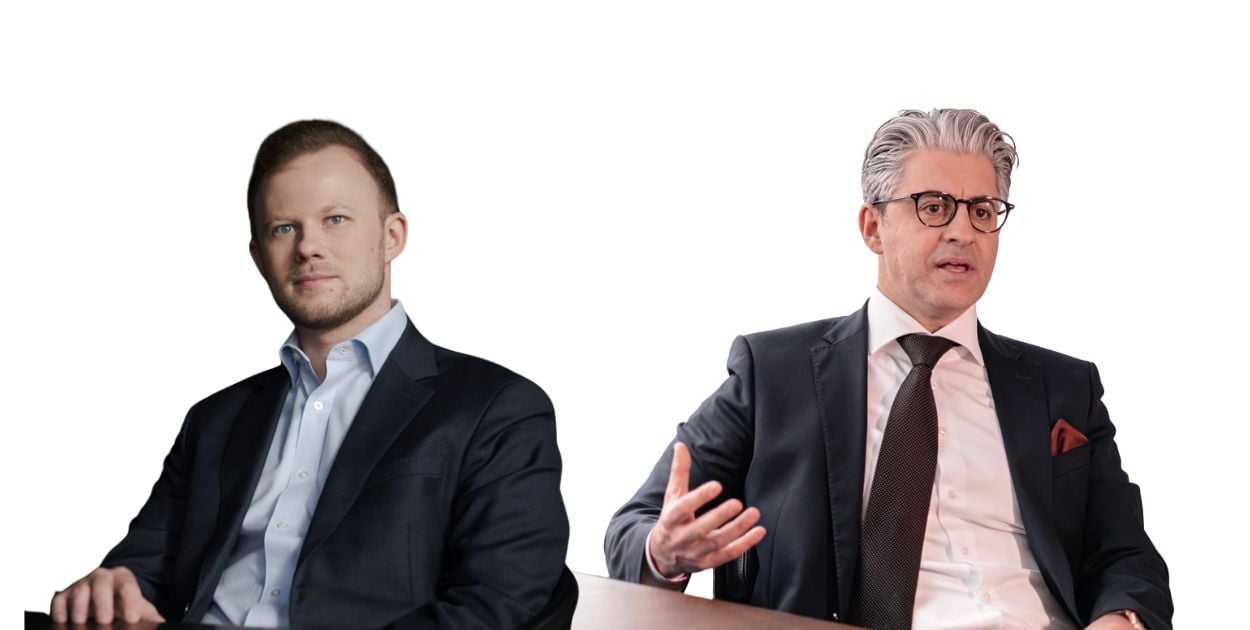
For Alexey Ivanov and Oleg Falikowitsch, the growth of independent fund managers depends less on the adoption of AI than on a preliminary step that is often overlooked: the digitalisation and integration of processes. Here, they discuss the operational weaknesses of the current model, new client behaviours and the technological drivers that could reshape the sector for the long term.
You state that Swiss independent wealth managers have a three-year window to ‘digitise or disappear’. Why do you believe the sector has now reached such a critical juncture?
Alexey Ivanov. Four major forces are simultaneously transforming the sector. Firstly, the intergenerational transfer of wealth. Secondly, increasing disintermediation via robo-advisers and ETFs. Thirdly, regulation. It is becoming more complex and licensing costs continue to rise. Finally, the major Swiss banks are investing heavily in technology and AI. Most of these trends have been around for years. What is changing now is that they are occurring at the same time and simultaneously impacting different parts of the business model. If we look at the pace of technological and market developments, everything is accelerating. There is no longer any business model that is completely protected or any segment that is truly immune to change within wealth management.
Growth in Swiss wealth management has, in recent years, been driven more by market performance than by new client inflows. To what extent is the traditional EAM model reaching its limits?
Alexey Ivanov. The overall figures remain solid, but we are nonetheless seeing profound structural changes. Revenue models are evolving, profitability is under pressure and client expectations are changing. Traditional wealth management was based on personal relationships, long-term family ties and regular meetings. Younger generations behave differently. They expect more interaction, digital channels and more sophisticated discussions about their investments.
Oleg Falikowitsch. Clients now have access to far more information. They use AI and digital tools and can carry out certain simulations themselves. They are therefore able to form well-founded opinions and challenge their adviser on investment strategy. This forces fund managers to constantly refresh their ideas and demonstrate their expertise. Sticking to the same investment universe, using the same methodology, is becoming increasingly difficult.
What are the main operational weaknesses of Swiss EAMs compared to private banks?
Alexey Ivanov. When it comes to the quality of advice and client relationships, EAMs often have the upper hand. The weakness lies in operations. Many independent firms still work with several non-integrated systems. Data and documents are often scattered across Excel spreadsheets and shared drives. Portfolio managers can realistically only cover a fairly limited investment universe. Banks have larger research teams, more structured processes and better-integrated tools.
Oleg Falikowitsch. In many respects, the sector still operates much as it did twenty years ago. Fund managers often analyse portfolios one by one, whereas systems should be proactive. The portfolio should, in a sense, flag up the need for intervention when necessary. To achieve this, data from KYC, transactions, liquidity and client activity must be integrated into a single environment.
You also highlight the significant amount of time relationship managers still spend on administrative tasks or compliance. Is AI in wealth management more a question of productivity than of investment?
Oleg Falikowitsch. The first step is not AI. It is the digitalisation and integration of processes. At present, systems remain fragmented and staff spend a great deal of time passing information back and forth between each other. Digitising certain processes can yield efficiency gains of up to 70–90 per cent. AI then comes into play to optimise and accelerate these processes.
Alexey Ivanov. Operational efficiency is important, but the central issue is that of opportunity cost. A significant proportion of time is still spent on administrative tasks that do not generate revenue. This is time not spent with clients, nor devoted to research or generating new ideas. AI must therefore be seen as a tool for broadening investment horizons and improving customer relations.
Players such as UBS, Julius Baer and Pictet are investing heavily in AI. How can independent EAMs remain competitive against them?
Alexey Ivanov. Banks will always have larger budgets. But they are also bigger, less agile and constrained by cumbersome internal processes. Technology projects in large institutions often take years to complete. EAMs can differentiate themselves in other ways – by moving faster, staying closer to clients and resolving specific operational issues much more quickly. The aim is not to transform everything at once, but to identify the most significant pain points and improve them gradually.
You argue that EAMs can outperform large banks thanks to their speed, proximity and proactivity. Is this still enough in a world where technology is becoming increasingly capital-intensive?
Oleg Falikowitsch. The relational advantage of EAMs should not be taken for granted. Banks are also adopting AI and will increasingly use behavioural analysis and data. The long-standing argument that ‘we know our customers better’ could lose its force. EAMs will need to rethink their positioning and use technology to preserve this advantage. Otherwise, the gap with the banks risks gradually narrowing.
With FinUp, are you simply seeking to improve the operational efficiency of independent asset managers, or to redefine the Swiss wealth management model?
Alexey Ivanov. FinUp was born out of operational challenges, but the vision is broader. Most current systems force managers to adapt to predefined processes. They work as long as one stays within the framework provided by the supplier and within a modular structure comprising PMS, CRM and risk engine modules, etc. The problem arises when processes need to be adapted or multiple systems need to be connected. We believe the sector must move away from isolated technological modules towards an approach centred on end-to-end processes and user journeys.
With FinUp, our aim is not simply to build a portfolio management tool. We are developing a platform that brings together investment workflows, client interactions, compliance processes and operational monitoring within a single environment. The idea is to enable EAMs to operate with institutional-grade capabilities whilst retaining their entrepreneurial flexibility.
Oleg, you founded FinUp after running your own EAM firm in Switzerland. What inefficiencies personally convinced you of the need for new tools?
Oleg Falikowitsch. It was all done manually! You’d receive an email confirmation, switch to another system, search for the client, update the advisory notes, store the documents separately, and start all over again. This creates huge inefficiencies and makes it difficult to ensure completeness and accuracy. Our aim was to cover the entire process, from the investment idea through to execution and follow-up.
Many fund managers talk about AI, but few of them have identified concrete use cases. What operational problems are you prioritising to solve with FinUp?
Alexey Ivanov. Investment proposals, for example. At present, the process is fragmented across several tools. With FinUp, portfolio modelling, compliance checks, liquidity management, proposal generation, client approval and execution are all integrated. We’re also focusing on monitoring, with alerts at the instrument level and visibility into the relevant portfolios. The aim isn’t just automation, but the creation of a complete workflow.
Among independent asset managers, what are the main misconceptions regarding the adoption of AI?
Oleg Falikowitsch. There is still a great deal of conservatism. Many organisations are concerned about security risks and remain reluctant to use the cloud. In reality, some traditional infrastructures may be less secure than modern cloud environments.
The most widespread misconception is the belief that the market will remain unchanged. However, the entire sector is set to evolve, whether players are ready or not. The question is whether they prefer to be part of this transformation or simply endure it.